
A tennis court might look simple on television, but every line, measurement, and boundary has a specific purpose.
Whether you play tennis recreationally, follow professional tournaments, or plan to build a court, knowing its dimensions can help you understand the game better. The good news is that tennis courts follow standard measurements for official play.
In this guide, I will explain the length, width, net height, and other important dimensions of a tennis court.
How Big Is a Tennis Court?
A standard tennis court is 78 feet long, but its width depends on whether you are playing singles or doubles. The court measures 27 feet wide for singles matches and 36 feet wide for doubles matches.
These measurements are standard for regulation tennis courts, including those used in professional tournaments.
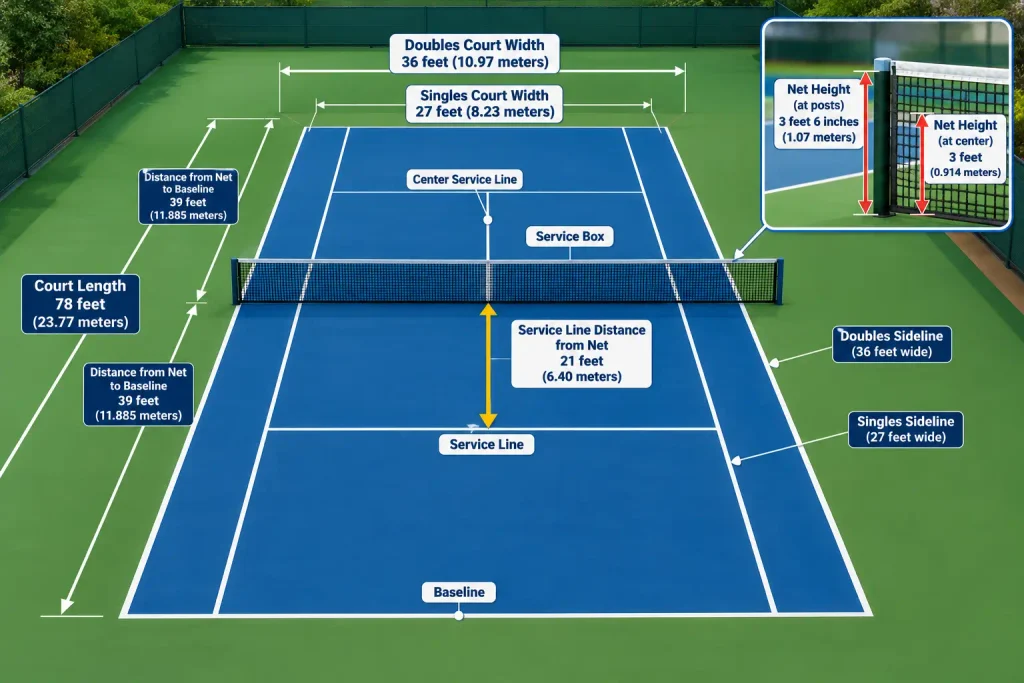
Complete Dimensions of the Tennis Court
The overall playing area is divided into two halves by a net, with:
- Service boxes
- Baselines
- Sidelines
Also, there are other markings which define where players can hit the ball. Here is a quick overview of standard tennis court dimensions.
| Court Measurement | Dimensions |
|---|---|
| Court length | 78 feet (23.77 meters) |
| Singles court width | 27 feet (8.23 meters) |
| Doubles court width | 36 feet (10.97 meters) |
| Net height at the posts | 3 feet 6 inches (1.07 meters) |
| Net height at the center | 3 feet (0.914 meters) |
| Distance from net to each baseline | 39 feet (11.885 meters) |
| Service line distance from the net | 21 feet (6.40 meters) |
What Is the Length of a Tennis Court?
The standard length of a tennis court is 78 feet, equivalent to approximately 23.77 meters. This measurement remains the same for singles and doubles matches.
The court is divided into two equal halves by the net, giving each side a length of 39 feet from the net to the baseline. The baseline is the line at the back of each side, and players use it as a reference when serving and returning shots.
If you watch professional tennis, you will notice that players frequently move forward and backward within their half of the court. The 39 foot distance between the net and baseline gives them room to defend deep shots, approach the net, and change their positioning during rallies.
What Is the Width of a Tennis Court?
The width of a tennis court depends on the type of match being played.
- Singles matches use a narrower playing area.
- Doubles matches include additional space on both sides.
Singles Court Width
A singles tennis court measures 27 feet wide, or approximately 8.23 meters. This is the playing width used when one player competes against another.
The narrower court means singles players must cover the entire width themselves. They need a combination of speed, endurance, and accurate shot placement to keep their opponents moving around the court.
Doubles Court Width
A doubles tennis court measures 36 feet wide, or approximately 10.97 meters. The extra width comes from the doubles alleys, the additional strips of court located along both sides.
These alleys count as part of the playing area in doubles matches but are out of bounds during singles rallies. The extra width gives teams more angles for attacking shots and requires players to coordinate their positioning with their partners.
What Is the Height of a Tennis Court Net?
The net measures 3 feet 6 inches high at the posts and 3 feet high at the center. It is lower in the middle because it is pulled down by a center strap attached to the court surface.
The tennis net is one of the most important parts of the court because it separates the two players or teams. Its height is carefully regulated to maintain consistent playing conditions.
This difference affects how players approach their shots. A ball must clear the net while remaining inside the opponent’s court, so players need to consider both the height of the net and the trajectory of the ball.
How Far Is the Service Line From the Net?
The service line is located 21 feet from the net on each side of the court. It runs parallel to the net and marks the back boundary of the service boxes.
When serving, players must hit the ball diagonally into the opponent’s service box. The service line helps determine whether the serve lands within the correct area.
The service boxes are also divided by a center service line, which separates the left and right service courts. These markings are essential because a serve that lands outside the correct service box is considered a fault.
Why Are Tennis Court Dimensions Important?
Standard court dimensions ensure that players compete under consistent conditions. Without uniform measurements, the difficulty of serving, returning shots, and covering the court could vary considerably between venues.
Court dimensions also influence playing strategy. Singles players need to cover a narrower court alone, while doubles teams use the additional width to create angles and attack open spaces.
The net height and service box dimensions also shape how players develop their techniques. A well placed serve, a controlled volley, or a deep groundstroke all depend on understanding the boundaries and layout of the court.
Last Take
A standard tennis court measures 78 feet long, 27 feet wide for singles, and 36 feet wide for doubles.
The net stands 3 feet high at the center and 3 feet 6 inches at the posts, while the service line sits 21 feet from the net. These measurements create consistent playing conditions across recreational and professional tennis.
I recommend remembering the difference between singles and doubles width because it is one of the easiest details to overlook.
About the Author